
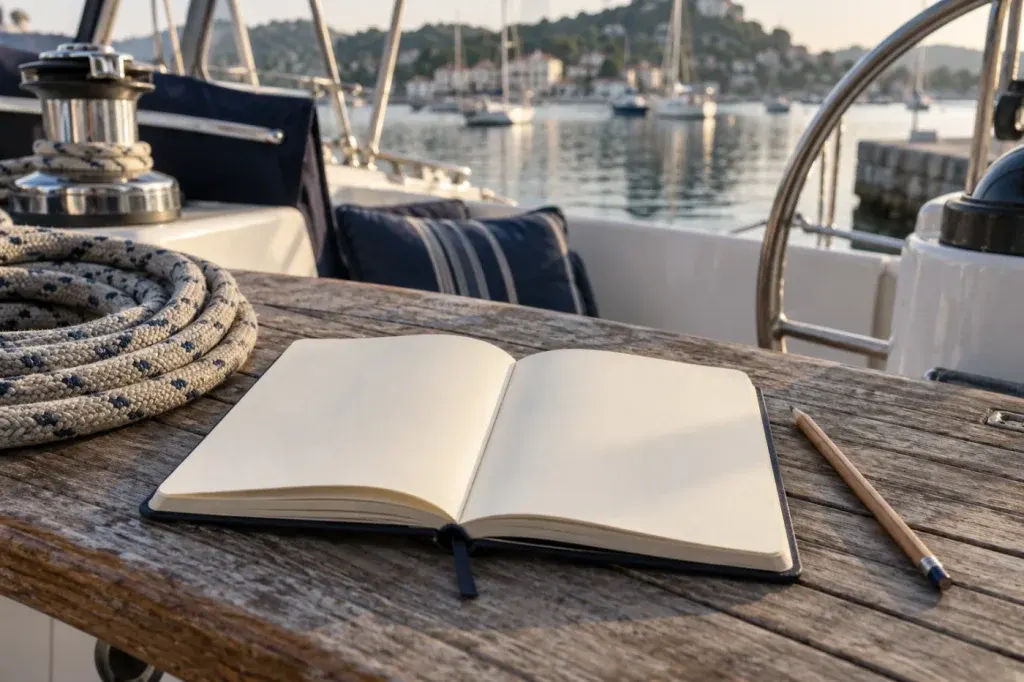
A page of times and place names can tell you where a day went. It may tell you very little about what made it memorable. A personal sailing journal has room for both: enough detail to recognise the outing, and a few sentences that bring it back.
You do not need a special notebook. Choose something you enjoy writing in, or keep a dated note on your phone and transfer it later. The best format is the one you are willing to use when you are tired and there is washing-up to do.
Give each entry three small parts
Begin with a heading: date, place and the people you sailed with. Add times only when you know them, and label estimates as estimates. For a personal record, an honest blank is more useful than a precise-looking guess.
Then write one observation you would otherwise forget. Perhaps it was the sound of halyards against masts while you waited on the quay, or the way a familiar headland looked different from the water. Specific details make stronger memories than declaring that everything was beautiful.
Finish with a question. It could be a word you heard, a book someone mentioned, or a feature of the harbour you want to understand. A question gives the next entry somewhere to begin.
A short example
Illustrative entry, not a reported voyage: Late afternoon, back alongside. The harbour grew quiet as the small boats returned. I finally remembered which side was port without turning towards the bow first. Next time: ask why that patch of water beside the entrance looked different.
The example is deliberately brief. You could add a sketch, a ticket from the ferry home or a photograph caption. There is no requirement to fill a page every time you go aboard.
Separate memory from a working record
This kind of journal is personal writing. It does not replace a vessel’s required log, passage plan, training record or the skipper’s instructions. Keep operational information in the format appropriate to the boat and its use; let the personal notebook do its own job.
When an observation raises a technical question, mark it for checking rather than turning it into advice. Our introduction to tides and currents, for example, distinguishes two ideas that are easy to mix up when watching a harbour.
Read back before the next outing
Spend a minute with the previous entry. Follow up one question, and leave the rest for another day. Over time, those small notes become a record of what you noticed and learned, rather than a collection of pages you felt obliged to complete.